
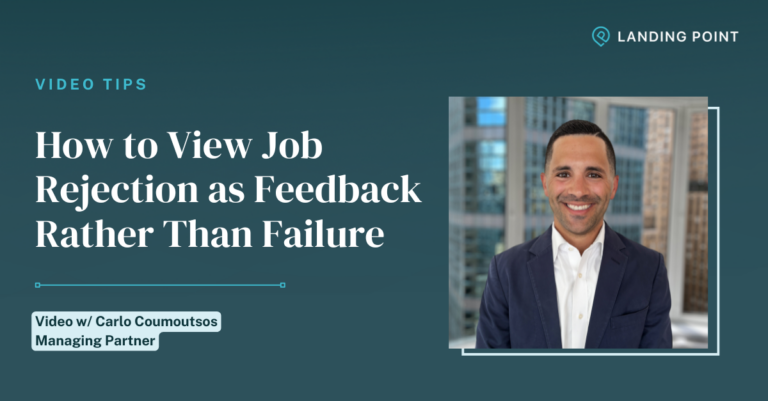
By Carlo Coumoutsos, Managing Partner
Few moments in a job search are more difficult than hearing that you didn’t get the offer. After multiple interviews, hours of preparation, and emotional investment, receiving a rejection can feel deeply personal. It’s natural to feel disappointed or even question your abilities, especially after making it to the final stages of the hiring process.
What many candidates don’t realize is that rejection is often a normal part of the hiring process—not a reflection of their potential or long-term career prospects. Companies make hiring decisions for countless reasons, many of which have little to do with a candidate’s qualifications. The key is how you respond. Viewing rejection as feedback rather than failure allows you to maintain momentum and position yourself for the next opportunity.
In this video, Carlo Coumoutsos, Managing Partner at Landing Point, shares a candid perspective on one of the hardest parts of recruiting: delivering disappointing news. He explains why candidates shouldn’t let one rejection define their job search and how resilience often leads to the right opportunity.
Watch the Video
[Carlo Coumoutsos, Managing Partner at Landing Point, discusses how candidates can handle job rejection with resilience and continue moving forward in their job search.]
Key Takeaways
One of the most overlooked aspects of recruiting is the difficult conversation that follows an unsuccessful interview process. Behind every rejection is someone who dedicated significant time and energy to the opportunity.
The most successful job seekers understand that hiring decisions are rarely black and white. Sometimes another candidate has slightly more specialized experience. Sometimes internal priorities shift. Occasionally, a role is placed on hold altogether. These outcomes can be frustrating, but they aren’t always within a candidate’s control.
Rather than viewing rejection as a personal failure, use it as an opportunity to learn and grow. If feedback is available, embrace it with an open mind. It may highlight areas you can strengthen before your next interview or simply reinforce what you’re already doing well. Either way, every interview is valuable experience that helps prepare you for future opportunities.
Resilience is one of the most important qualities a candidate can develop during a job search. The role that feels like a setback today may ultimately lead you to an opportunity that’s an even better fit for your goals, skills, and long-term career aspirations. It’s not uncommon for candidates who were runners-up for one position to become the first choice for another just weeks later.
A successful job search is rarely defined by a single interview or one hiring decision. It’s defined by persistence, adaptability, and the willingness to keep moving forward. The candidates who ultimately land the right opportunity are often the ones who refuse to let temporary disappointment become a permanent roadblock.
Transcript
Carlo Coumoutsos:
There’s a part of recruiting that’s not often talked about, and that’s the difficult conversations recruiters have to have with candidates.
It’s the call where you tell someone they didn’t get the job they wanted. The call explaining they’ve been passed over after multiple rounds in favor of another candidate. Or the conversation where the role they’ve invested so much time in has suddenly been put on hold.
On the other end of those calls is someone who’s poured their time, energy, and emotion into the process. They’re frustrated, disappointed, and sometimes even questioning themselves.
As recruiters, it’s our responsibility to empathize with candidates while also reminding them that a “no” during one interview process is not a verdict on their career or their job search.
Instead of internalizing rejection, candidates should use any feedback they’re given, continue building on their strengths, and keep moving forward.
Because the same candidate who doesn’t receive one offer can very easily become the top choice for the very next opportunity.
About Carlo Coumoutsos
Carlo Coumoutsos is the Managing Partner at Landing Point, where he oversees the firm’s Accounting & Finance, Capital Formation & Investment Support, and Tax & Family Office practices. He partners with clients across the Tri-State area and beyond on executive search and finance leadership hiring for asset management, private equity, and family office platforms.
With a background as a CPA and former PwC auditor, Carlo brings precision, credibility, and deep financial acumen to every search. Notable searches include CFOs and financial leadership roles across diverse investment entities and multi-family offices.
A hands-on mentor and integral part of Landing Point’s growth, Carlo leads the firm’s training programs, continuing education, and partnerships with academic and community organizations that support career readiness. He is known for a balanced approach that combines technical expertise with relationship depth and long-term client partnership.
Carlo holds both a BS and MS in Accounting from Fordham University and lives in New York with his wife and four sons.