
By Carlo Coumoutsos, Managing Partner at Landing Point
Why Compensation Strategy Matters Going Into 2026
As we head into 2026, hiring managers should be re-evaluating compensation strategies to remain competitive in an evolving market. Whether you’re hiring your first team member or managing a large department, compensation discussions shape your ability to attract, secure, and retain top talent. Professionals today are more informed than ever, and their expectations around salary, benefits, transparency, and growth opportunities reflect the realities of a tightening labor market.
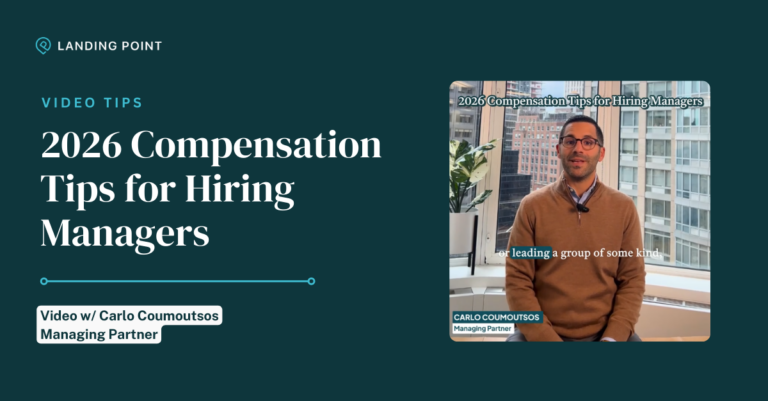
A strong compensation strategy isn’t just about numbers, it’s about preparation and alignment. Understanding how to benchmark roles, communicate clearly, and set expectations helps leaders avoid misalignment late in the process and ensures top talent remains engaged. In this video, Carlo Coumoutsos shares practical advice for hiring managers to refine their compensation approach heading into 2026.
[Carlo Coumoutsos, Managing Partner at Landing Point, shares key compensation tips for hiring managers as they prepare for the 2026 hiring cycle.]
Key Takeaways
Preparation is everything: Managers should collect up-to-date compensation market data based on their geographic location.
Align internally before meeting with employees: Make sure your team agrees on compensation ranges, promotion paths, and expectations.
Ensure clarity on next steps: Leave every compensation conversation fully aligned so you and your employees are moving toward the same 2026 goals.
A thoughtful compensation strategy builds trust with employees and removes ambiguity from the year ahead. When leaders benchmark effectively, prepare talking points, and come ready to discuss career paths or potential promotions, it signals confidence and professionalism—qualities that your employees will value deeply.
Related reading: Hiring Managers, Let’s Raise the Bar on Interviews
Want Support Navigating 2026 Compensation Strategies?
Landing Point partners with hiring managers to benchmark roles, structure competitive compensation, and secure top talent. If you still need 2026 compensation guidance and want market insights tailored to your team, contact us to connect with one of our Managing Partners or senior recruiters.
Transcript
Carlo Coumoutsos:
If you are a hiring manager or leading a group of some kind, you’re probably in the midst of compensation discussions internally. First and foremost, you have to have up-to-date, accurate market data. You have to make sure that data comes from a reliable source that works within your industry and geographic location.
For example, if you’re the CFO of a private equity firm in midtown Manhattan, national financial services survey data is often too broad and not reflective of your true market.
Next, you want to identify your top performers—the people who would leave a real gap if they exited your team. You should aim to pay them at the top end of the market, based on what they could command if they went to market today.
You’ll also have solid performers who should be paid fairly, but it’s okay to have separation between top-tier talent and the next level. Regardless of how compensation shakes out, transparency is key.
Compensation goes up and down. Performance varies. People understand that pay reflects individual results, firm performance, and market conditions—but they need context. When you clearly explain the rationale behind compensation decisions, you build trust, respect, and loyalty that carries into 2026 and beyond.
About Carlo Coumoutsos
Carlo Coumoutsos is Managing Partner at Landing Point, where he oversees the firm’s Accounting & Finance, Capital Formation & Investment Support, and Tax & Family Office practices. He partners with clients across the Tri-State area and beyond on executive search and finance leadership hiring for asset management, private equity, and family office platforms.
With a background as a CPA and former PwC auditor, Carlo brings precision, credibility, and deep financial acumen to every search. Notable searches include CFOs and broader financial leadership roles across diverse investment entities and multi-family offices.
A hands-on mentor and an integral part of Landing Point’s growth, Carlo leads Landing Point’s training programs, continuing education, and partnerships with academic and community organizations that support career readiness. He is known for a balanced approach that combines technical expertise with relationship depth and long-term client partnership.
Carlo holds both a BS and an MS in Accounting from Fordham University and lives in New York with his wife and four sons.