
By: Zoie Teytelbaum, Managing Director, HR & Talent Acquisition
In Building Your HR Function: A Practical Guide for COOs & CFOs at Growing Asset Managers, we outlined what a lean but mighty HR function looks like for growing asset management firms—and why relying on “scrappy” HR solutions eventually creates friction for leadership.
The next question we hear from COOs and CFOs is far more practical:
“If I can only hire one HR person this year, who should it be?”
The answer is rarely obvious. Most firms don’t need a full HR department, and hiring the wrong role too early can create as many problems as it solves. What does work is understanding the key HR archetypes, what business problems they address, and when each one becomes necessary.
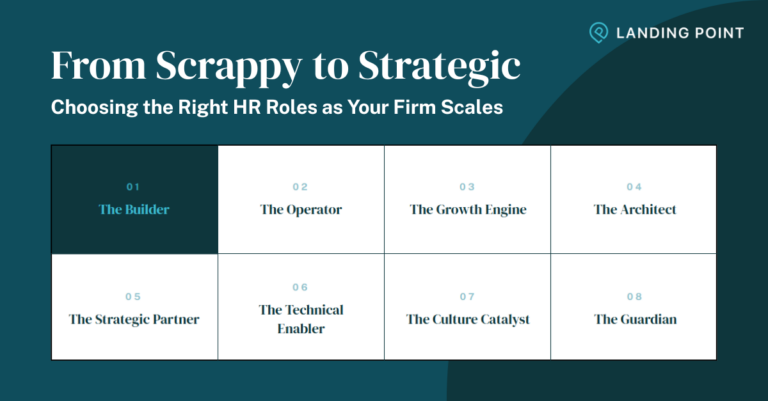
Below is a practical guide to eight HR and talent roles that commonly show up as firms scale, along with guidance on when each makes sense and what pressure it removes from leadership.
Important context:
You do not need all eight of these roles.
Most firms under ~150 employees only need one or two—at the right level.
Want personalized guidance on which HR archetype best suits your growing organization’s needs? Check out our interactive tool:
1. The Builder
Head of HR / Head of People / HR Manager
When this role makes sense
- HR decisions sit with Finance or Operations
- Policies, performance reviews, and compensation feel inconsistent
- You’re reacting to people issues instead of anticipating them
What this role takes off your plate
- Day-to-day HR decision-making
- Policy interpretation and compliance guesswork
- Designing processes from scratch
Why firms hire this role first
This is often the highest-leverage first HR hire. The Builder establishes foundational infrastructure (policies, performance cycles, onboarding, and governance) so leadership can stop reinventing the wheel.
Common mistake
Hiring too junior and expecting strategic leadership.
2. The Operator
HR Generalist / HR Operations Manager
When this role makes sense
- HR processes exist, but execution is inconsistent
- Benefits, payroll, and documentation consume internal bandwidth
- Employees lack a clear point of contact for HR questions
What this role takes off your plate
- Administrative HR tasks
- Benefits and leave management
- Employee lifecycle coordination
Best used when
Paired with senior HR leadership—internal or fractional—who sets direction.
3. The Growth Engine
Director of Talent Acquisition / Recruiting Lead
When this role makes sense
- Hiring managers are stretched thin
- External recruiters are costly and inconsistent
- Time-to-hire is slowing growth
What this role takes off your plate
- Coordinating searches and agencies
- Managing candidate experience
- Building repeatable hiring processes
Watch out for
Hiring this role before role clarity, comp frameworks, or approval processes exist.
4. The Architect
Compensation & Total Rewards Lead
When this role makes sense
- Compensation decisions live entirely with the CFO
- Bonus cycles are stressful and opaque
- Pay decisions feel reactive rather than principled
What this role takes off your plate
- Compensation modeling and benchmarking
- Bonus administration complexity
- Benefits vendor oversight
Often delayed, but shouldn’t be
Firms frequently underestimate how early compensation complexity emerges in asset management.
5. The Strategic Partner
HR Business Partner / People & Culture Advisor
When this role makes sense
- Leadership decisions are outpacing people strategy
- Succession, performance, or engagement issues are emerging
- Managers need guidance navigating sensitive situations
What this role takes off your plate
- Coaching managers through people decisions
- Anticipating retention and performance risks
- Translating business strategy into workforce planning
Best positioned as
A senior advisor, not a catch-all problem solver.
6. The Technical Enabler
People Analytics & HR Systems Lead
When this role makes sense
- HR data is fragmented or unreliable
- Finance and HR are working from different numbers
- Forecasting headcount feels manual and risky
What this role takes off your plate
- System integrations and reporting
- Manual data reconciliation
- Ad-hoc workforce analysis
Usually needed
After core HR leadership and processes are in place.
7. The Culture Catalyst
Learning & Development / Culture Lead
When this role makes sense
- Retention becomes a concern
- Managers lack people leadership skills
- Growth is outpacing cultural clarity
What this role takes off your plate
- Designing training and development programs
- Running engagement initiatives
- Creating consistency in leadership behaviors
Often comes later
But becomes critical as teams and layers grow.
8. The Guardian
HR Compliance / Employee Relations Lead
When this role makes sense
- Employee relations issues increase in complexity
- Regulatory risk is rising
- Investigations and policy enforcement require consistency
What this role takes off your plate
- Managing investigations and disciplinary actions
- Keeping policies current with employment law
- Partnering with legal and compliance teams
Typically added
As scale, regulation, and risk exposure increase.
Roles You Likely Don’t Need Yet
(And That’s Okay)
Many firms feel pressure to professionalize everything at once. In reality, roles like People Analytics, L&D, or dedicated Compliance leadership are often premature until foundational HR leadership is in place.
Intentional sequencing matters more than speed.
How to Decide What Comes First
If you’re unsure which role to prioritize, ask yourself:
- Where is leadership spending the most unplanned time?
- Which people decisions feel riskiest to get wrong?
- What will break first if headcount grows another 25%?
The right HR hire isn’t about building a department. It’s about removing friction, reducing risk, and enabling leadership to focus on running the business.
At Landing Point, we work with COOs and CFOs to help them think through which HR role makes sense now, which can wait, and how to structure teams that stay lean as firms scale.
About Zoie Teytelbaum
Zoie Teytelbaum is a Managing Director at Landing Point, leading HR & Talent Acquisition executive search across the Tri-State area and Florida. With a background in sales and a sharp focus on operational and human capital leadership, she oversees searches for chief administrative officers, heads of human resources, and senior executive assistants within asset management, private equity, hedge fund, and family office platforms.
Zoie regularly advises clients on hiring trends, compensation benchmarking, and candidate experience strategy, often mentoring fund leaders who are launching or scaling new teams. As someone integral to the growth of Landing Point, she also spearheads initiatives to elevate internal collaboration and technology adoption. A Florida native and University of Florida graduate, Zoie loves stand-up comedy, exploring coastal cities, and discovering new restaurants with her husband.