
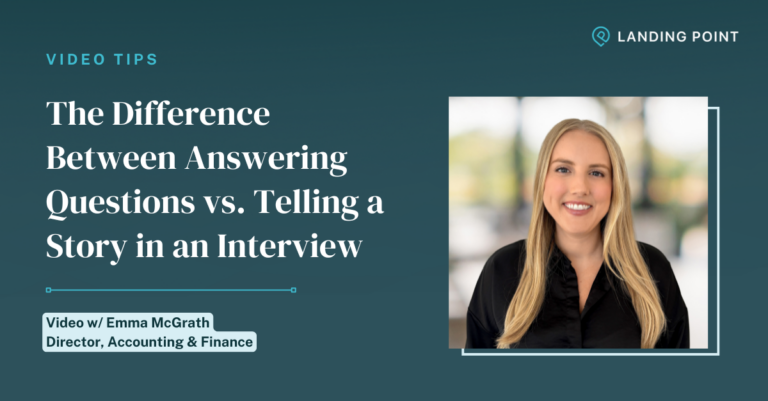
By Emma McGrath, Director, Accounting & Finance at Landing Point
An interview is more than just an opportunity to answer questions about your resume. While candidates often focus on making sure they can clearly explain their experience, simply listing responsibilities or providing short answers may not give an interviewer a strong understanding of what you actually did. The strongest candidates know how to turn the experience on paper into a story.
In this video, Emma McGrath, Director on Landing Point’s Accounting & Finance team, explains why candidates should focus on telling a story when discussing their professional background and how doing so can help them demonstrate their experience more effectively.
Watch the Video
[Emma McGrath, Director on Landing Point’s Accounting & Finance team, explains why candidates should tell stories about their experience rather than simply answer questions during an interview.]
Key Takeaways
When an interviewer asks about your background, it’s easy to fall into the habit of giving a straightforward answer and moving on to the next question. A response like “I worked on valuation” doesn’t tell an interviewer very much about your actual experience.
- What type of valuation work did you perform?
- What was your role?
- Who did you work with?
- What steps did you take?
Turning that answer into a story gives the interviewer a much better understanding of your capabilities. Discussing your experience in areas like valuation allows you to explain the actual work behind a responsibility. Rather than simply stating that you worked on valuation, describe receiving files from the client, determining materiality thresholds, establishing sample sizes, ticking and tying, and obtaining third-party corroborating support.
That level of detail helps paint a clearer picture of what you actually did. It also gives the interviewer more opportunities to understand how your experience could translate to their own organization.
Your story doesn’t need to be directly identical to the work performed by the company you’re interviewing with. Even if a prospective employer approaches a project differently, demonstrating that you have worked through complex processes, collaborated with different groups, and taken ownership of your responsibilities can still be valuable.
The goal isn’t to make every answer unnecessarily long. Instead, focus on providing enough context to make your experience meaningful. Think about the projects, challenges, and responsibilities that best demonstrate your skills, and practice explaining them in a way that allows the interviewer to understand not just what you did, but how you did it.
Ultimately, strong interview storytelling helps transform your resume from a list of experiences into a clear picture of the professional you are and gives the interviewer a better understanding of the value you could bring to their organization.
Looking Ahead
Preparing for an interview goes beyond reviewing your resume. At Landing Point, we work closely with candidates to help them prepare for interviews, communicate their experience effectively, and put their best foot forward throughout the hiring process. If you’re considering your next career move, connect with our team to learn how we can support your search.
Transcript
The Difference Between Answering Questions vs. Telling a Story in an Interview
There is a big difference between candidates answering questions versus telling a story. I highly recommend, when you’re talking through your resume and your background in an interview, to tell a story about what it is that you’re doing and what you’re working on.
For example, as an accountant, a lot of times people can work on valuation as a substantive testing area.
When I was an auditor, I worked on valuation where we got the files from the client, we got our materiality thresholds, we got our sample size, we ticked and tied, and we got third-party corroborating support.
I’m telling a story, right? That I actually worked on valuation versus I say, “Yeah, I worked on valuation. It was really hard and I got my work done.”
Firms are not going to think you’re engaged. If you construct a story around who you’re working with, different groups, and different teams, regardless of whether this new firm does exactly that, it is still really beneficial.
So try and paint a picture.
About Emma McGrath
Emma McGrath, CPA, is a Director on the Accounting & Finance team at Landing Point, specializing in executive search and finance leadership hiring across New York, Connecticut, New Jersey, Florida, California, and Texas. Emma has experience working at EY in Financial Services Audit and a Hedge Fund, working on Fund Accounting & Operations. She connects top finance talent with leading firms in private equity, hedge funds, venture capital, and real estate.
Notable searches include placing Big 4 auditors into FP&A, Finance Analysts, and Fund Accounting & Operations opportunities at dynamic venture capital and alternative investment organizations. Emma advises clients on compensation expectations, hiring trends, and candidate experience, while coaching early-career finance professionals on career pivot planning. Her approach blends analytical precision with empathy and long-term relationship building.
Emma graduated with a B.S. from the University of Scranton and an M.S. in Accountancy from SUNY Old Westbury. She spends her free time visiting family in Ireland, traveling through Europe, and enjoying Pilates and Barry’s classes around New York City.