
By: Melanie Kilsey Merner – Managing Director, Boston Office
When I talk with CFOs and CHROs at life sciences companies approaching commercialization, one theme comes up repeatedly:
“We know we’re going to need to hire… we just aren’t sure in what order.”
That hesitation makes sense. Headcount decisions at this stage carry weight, both financially and strategically.
In my experience working with life sciences organizations in Boston, Cambridge, and Metro West, certain roles consistently create stability and reduce risk when hired proactively instead of reactively.
When biotech companies approach commercialization, hiring typically ramps up fast. However, scaling well isn’t just about adding headcount, it’s about adding the right infrastructure roles at the right time.
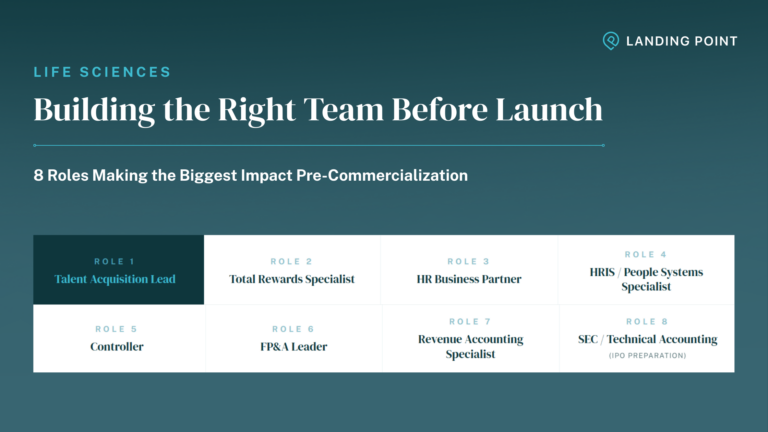
The eight positions outlined below are roles that I consistently see make the biggest impact when hired pre-commercialization rather than reactively. If you’re in a stage where a full-time hire feels premature, the good news is that contract or contract-to-hire solutions for any of these roles can provide flexibility. It gives you the opportunity to assess skills, culture fit, and business needs before committing permanently.

HR & People Infrastructure Roles:
1. Talent Acquisition Lead
When hiring accelerates, relying solely on agencies or a generalist HR function quickly becomes unsustainable.
A dedicated TA leader builds:
- Structured interview processes
- Employer branding in a competitive biotech market
- Forecast-driven hiring pipelines
Without this role, hiring becomes chaotic and inconsistent.
2. Total Rewards Specialist
Commercial-stage companies face new compensation pressures:
- Market compression in Boston biotech
- Equity refresh expectations
- Sales compensation planning
- Retention risk among early employees
A Total Rewards leader ensures comp structures evolve thoughtfully rather than in response mode.
3. HR Business Partner
As teams expand (especially commercial teams), organizational design becomes more complex.
An experienced HRBP helps:
- Align leadership expectations
- Build performance management frameworks
- Support change management during rapid growth
This role often becomes the stabilizer during transition.
4. HRIS / People Systems Specialist
Scaling exposes system gaps quickly.
Manual processes that worked at 150 employees can become operational risk at 400.
An HRIS leader ensures:
- Clean data
- Reporting capabilities
- Compliance support
- Integration with finance systems
Finance Infrastructure Roles:
5. Controller
As commercialization approaches, accounting complexity increases:
- Inventory considerations (for certain models)
- Revenue recognition
- Stronger close discipline
- Audit readiness
A strong Controller creates operational confidence.
6. FP&A Leader
Commercial forecasting is very different from R&D burn forecasting.
Scenario modeling must now account for:
- Revenue timing variability
- Market penetration assumptions
- Commercial hiring pace
- Cash runway sensitivity
An experienced FP&A lead helps leadership make better forward-looking decisions.
7. Revenue Accounting Specialist
Revenue recognition under ASC 606 can become complex quickly, especially with milestone-based or partnership revenue.
Having this expertise internally avoids painful corrections later.
8. SEC / Technical Accounting (If IPO Is on the Horizon)
If IPO optionality is even a medium-term consideration, technical accounting strength becomes critical earlier than many companies expect.
Bringing this expertise in proactively reduces risk when timelines accelerate.
The Common Thread
Every one of these roles reduces risk during a pivotal growth stage.
Pre-commercialization is not just about preparing for launch. It’s about preparing your infrastructure for what follows.
The companies that invest in these roles strategically tend to scale more confidently with far fewer fire drills. In my conversations with leaders who have been through this transition before, there is often one shared reflection:
“I wish we had made those hires a bit earlier.”
Strategic hiring at this stage is not about adding overhead. It is about protecting momentum.
About Melanie Kilsey Merner
Melanie Kilsey Merner is a Managing Director at Landing Point, where she focuses on building high-performing Accounting & Finance and HR & Talent Acquisition teams. She brings nearly two decades of recruiting expertise to Landing Point’s Boston office, where she helps companies grow with confidence. Known for her ability to forge long-term relationships, she invests the time to understand each client’s business and culture, ensuring every placement strengthens the organization. Melanie partners closely with both employers and professionals to match skill sets with career goals, serving as a trusted advisor throughout the hiring process.
Outside of work, Melanie is passionate about food, power yoga, and gardening. A lifelong water enthusiast, she enjoys paddleboarding, clamming, and soaking up the sun with her husband, daughter, and their dog, Peanut Butter.