
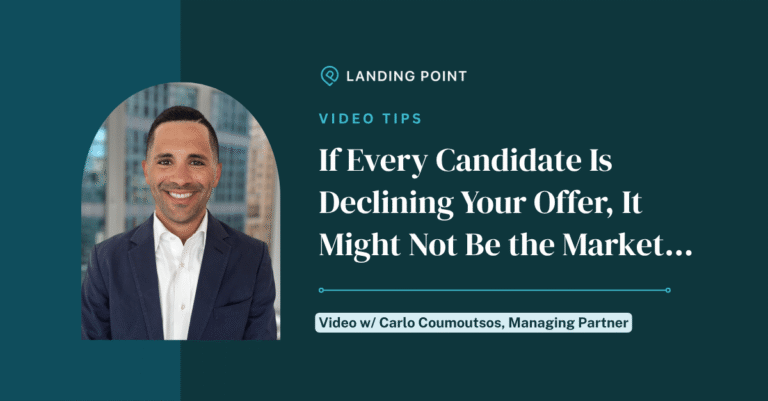
By Carlo Coumoutsos, Managing Partner at Landing Point
It’s a natural instinct for hiring managers to point to market conditions when candidates decline offers. While competition is high, talent is scarce, and expectations continue to rise, consistent offer rejections are rarely driven by the market alone.
When multiple candidates reach the final stages and choose not to move forward, it’s worth taking a closer look at your internal hiring process. From communication gaps to slow timelines to an unclear value proposition, even small breakdowns can significantly influence a candidate’s decision.
In this video, Carlo Coumoutsos explains why repeated offer declines can be a reflection of the process and what hiring managers should do to improve their ability to secure top talent.
[Carlo Coumoutsos, Managing Partner at Landing Point, explains why candidates decline offers and how hiring managers can improve their hiring process to secure top talent.]
Key Takeaways
Today’s candidates are more informed than ever. By the time they reach the offer stage, they have already formed strong opinions about your organization. Every interaction, from initial outreach through final interviews, shapes how they view your team, leadership, and the opportunity itself.
Timing is one of the most common breakdowns. A slow or disjointed interview process can create uncertainty and give competing opportunities the advantage. Top candidates are often evaluating multiple offers simultaneously, and delays can signal a lack of urgency or internal alignment.
Communication is equally critical. Candidates expect transparency around the role, expectations, compensation, and growth potential. When communication is inconsistent or unclear, it can erode trust and raise concerns about broader employee experience.
Positioning also plays a major role. Hiring managers sometimes assume strong candidates will naturally be drawn to the opportunity, but top talent expects to be actively engaged and persuaded on why the role stands out. Clearly articulating impact, growth, and long-term potential can be the deciding factor.
Compensation matters, not just in the numbers, but in what those numbers communicate. A competitive offer signals that a candidate is valued. When compensation feels misaligned with expectations or perceived market value, hesitation and ultimately rejection often follow.
The most effective hiring managers take a proactive approach. Rather than attributing declines solely to external factors, they evaluate their process, identify friction points, and make targeted improvements that enhance the candidate experience from start to finish.
Related Reading: The Hidden Drivers of Turnover
Looking Ahead
If you’re constantly seeing candidates decline offers, it may be time to reassess your hiring strategy. Landing Point partners with hiring managers to streamline processes, improve candidate experience, and ensure offers are competitive and aligned with market expectations.
If you’re looking to secure top talent more effectively, connect with our team to refine your approach and build a hiring process that delivers results.
Transcript
Carlo Coumoutsos:
I’ve had clients come to me recently and say that they have candidates moving forward in the process, getting to final stages, and for whatever reason, the candidates are declining offers.
Sometimes it might be bad luck, sometimes it might be the market—but if you’re seeing a consistent pattern, there might be something in your process that needs improving.
Are you moving in a timely manner? Are you efficient with your search? Are you being communicative with the recruiter and the candidate? Are you selling the opportunity in the most effective way possible?
And most importantly, are you showing candidates that they’re valued and will be recognized by making a strong and competitive offer?
Because the fact of the matter is, candidates are making moves. They’re taking that leap. And if they’re choosing not to do so with your firm, that might be something worth looking into.
The clients that are successful at hiring top talent are efficient, transparent, communicative, and they show candidates their value.
Instead of blaming the market, audit your process. That’s usually where the fix is.
About Carlo Coumoutsos
Carlo Coumoutsos is the Managing Partner at Landing Point, where he oversees the firm’s Accounting & Finance, Capital Formation & Investment Support, and Tax & Family Office practices. He partners with clients across the Tri-State area and beyond on executive search and finance leadership hiring for asset management, private equity, and family office platforms.
With a background as a CPA and former PwC auditor, Carlo brings precision, credibility, and deep financial acumen to every search. Notable searches include CFOs and financial leadership roles across diverse investment entities and multi-family offices.
A hands-on mentor and integral part of Landing Point’s growth, Carlo leads the firm’s training programs, continuing education, and partnerships with academic and community organizations that support career readiness. He is known for a balanced approach that combines technical expertise with relationship depth and long-term client partnership.
Carlo holds both a BS and MS in Accounting from Fordham University and lives in New York with his wife and four sons.