
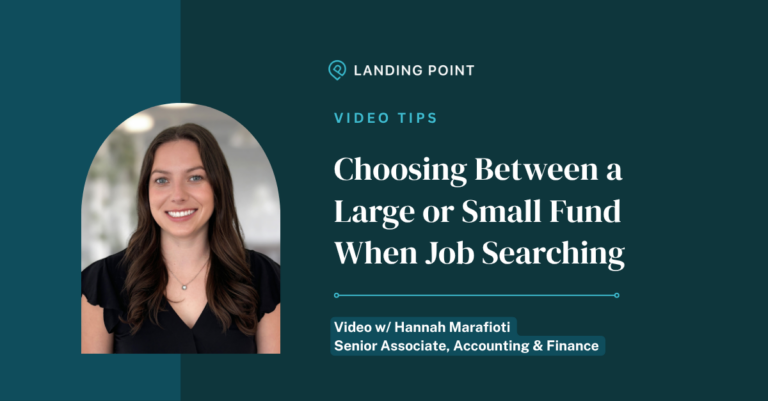
By Hannah Marafioti, Senior Associate, Accounting & Finance
For professionals coming from the Big Four who are considering a move into private markets, evaluating potential employers goes beyond the size or name of the fund. The structure of the organization can shape the scope of the role, exposure to senior leadership, team dynamics, and opportunities for growth.
In this video, Hannah Marafioti, Senior Associate on Landing Point’s Accounting & Finance team, discusses what candidates should consider when evaluating opportunities at larger and smaller funds and why keeping an open mind can lead to a better career fit.
Watch the Video
[Hannah Marafioti, Senior Associate on Landing Point’s Accounting & Finance team, discusses the differences between working at a large or small fund and what candidates should consider when evaluating each opportunity.]
The Smaller Fund
For Big Four professionals making a move into private markets, the size of a prospective employer can have a meaningful impact on the experience that follows. At a smaller fund, which is anything less than $50 billion in assets under management, an accounting professional may have more opportunities to work directly with senior leaders such as the Controller or CFO. The role may also extend beyond traditional fund accounting into operations or other middle-office functions, creating broader exposure to how the organization operates.
That broader exposure can be particularly valuable for candidates who want to expand their skill set and take on additional responsibility early in their careers. Working at a smaller firm may mean wearing more hats and interacting with different sectors of the business rather than focusing on one narrowly defined function.
The Larger Fund
Larger funds can offer a different set of advantages. A larger fund, anything greater than $50 billion in assets under management, may provide more opportunities for collaboration and a broader professional network. This can be particularly appealing to candidates who place a high value on team culture. Larger organizations may also offer opportunities for internal movement. Once an employee has established themselves in one function, there may be opportunities to transition into other back-office groups or explore different areas of the organization.
Ultimately, neither environment is one-size-fits-all. The right fit depends on what a candidate values most in the next stage of their career. Some professionals may prioritize broad exposure and increased responsibility, while others may value team size, culture, brand recognition, or the potential to move internally over time.
That’s why we recommend starting the search by casting a broad net. A candidate may initially believe that a larger fund is the right choice, only to interview with a smaller firm and discover that the level of exposure and responsibility is much more appealing. Going through the interview process can provide insight that isn’t always apparent from a job description or company profile.
Being open-minded throughout the process gives candidates the opportunity to learn what each environment actually offers and make a more informed decision about their next career move.
Looking Ahead
Considering a move from the Big Four or exploring opportunities within private markets? Landing Point’s Accounting & Finance team works closely with candidates to understand their career goals and connect them with opportunities that align with what matters most to them. Connect with our team to explore your next career move.
Transcript
Choosing Between a Large or Small Firm When Job Searching
If you’re a Big Four candidate and you’re looking to make a job move, you’re most likely choosing between a large or a small fund. A large fund is anywhere from $50 billion-plus in assets under management, and then a smaller fund is anything smaller than that.
Benefits of working at a smaller firm would be smaller firm in general in terms of headcount. Most likely, if you’re in accounting for a $10 billion fund, you could potentially be working with the Controller and the CFO, upper-level management, and your responsibilities might increase.
Instead of just doing solely fund accounting, you might deal with operations, you might have conversations with the other middle-office functions. The exposure that you would get at a smaller firm is a lot more broad.
For a larger firm, not only do you get a brand name on your resume, but the team size might be larger. Maybe culture is huge for you and you love having coworkers that you can collaborate with and hang out with outside of work.
Another benefit to working at a larger fund would be internal movement. There’s always a possibility that you could rotate around different back-office groups if you do a good job. You obviously have to prove yourself before you do that, but definitely a good reason to pick a larger firm with the understanding that you want to stay there a long time.
Depending on how the interview process goes, your preferences might change. My best advice would be to start your search by casting a broad net. And maybe you go into it thinking that you want the larger firm, but maybe you go into an interview for a smaller firm and you realize, wow, the exposure that I’m going to get here is awesome.
You never really know until you go through the process. Definitely be open-minded, and that’s how you’re ultimately going to decide whether you want a large or a small firm.
About Hannah Marafioti
Hannah Marafioti is a Senior Associate at Landing Point, specializing in Accounting & Finance executive search. Based in New York, she partners with investment firms nationwide to hire fund accounting and financial analysis professionals for asset management, private equity, venture capital, and hedge fund clients.
With a foundation as an auditor at a mid-size public accounting firm, Hannah applies technical rigor and an empathetic approach to align talent with long-term organizational goals. She regularly advises junior finance professionals on interview preparation and career transitions into the buy-side, helping them translate accounting skills into long-term finance leadership paths.
Hannah earned both her bachelor’s and master’s degrees in accounting from SUNY Geneseo, where she was also a student-athlete. Outside of work, she enjoys live music, cheering on the Buffalo Bills, and spending time with friends and family.