
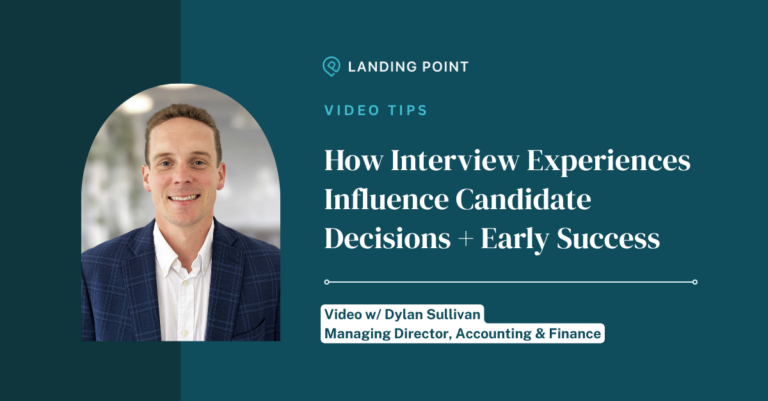
By Dylan Sullivan, Managing Director, Accounting & Finance
The interview process is often viewed as a way for employers to evaluate candidates, but at the same time, candidates are evaluating hiring managers and their firms. Today, the structure, communication, and overall experience of an interview process can significantly influence whether a candidate accepts an offer and how they perceive your organization from day one.
Candidates are paying close attention to every interaction. A process that feels disorganized, drawn out, or unclear can raise concerns about leadership and how the company operates internally. Even if the role itself is compelling, those early impressions can shape a candidate’s mindset before they even start.
Companies need to recognize that the interview experience is more than a logistical process; it’s a direct reflection of the organization. In this video, Dylan Sullivan, Managing Director on Landing Point’s Accounting & Finance team, shares insight into how interview experiences influence candidate decisions and why a smooth, well-communicated process plays a critical role in setting new hires up for success.
[Dylan Sullivan, Managing Director at Landing Point, explains how interview experience impacts candidate perception, acceptance decisions, and early success in a new role.]
Key Takeaways
One of the most overlooked aspects of hiring is how much weight candidates place on the interview experience itself. Every delay, lack of communication, or inconsistency can be interpreted as an inside look into how a company operates.
When a process feels choppy or unstructured, candidates may begin to question whether the organization is similarly disorganized behind the scenes. While that perception isn’t always accurate, it still has a real impact. Candidates often carry those assumptions with them, even if they ultimately accept the offer.
That becomes especially important during the first 90 to 120 days of a new role. This period is naturally challenging, even for top performers. Learning new systems, building relationships, and adjusting to a new environment requires time and energy. If a candidate enters that phase already feeling uncertain due to a poor interview experience, it can add additional stress to the process.
On the other hand, a smooth, well-structured interview process creates confidence. When candidates feel informed, supported, and communicated with throughout the process, they enter their new role with a stronger sense of clarity and trust. That foundation makes it easier to navigate the inevitable challenges of starting something new.
It’s important to recognize that a less-than-perfect process doesn’t always reflect the reality of the organization. Sometimes delays or inconsistencies are simply a product of circumstance. However, from a candidate’s perspective, perception becomes reality.
That’s why communication is so critical. Keeping candidates informed, setting clear expectations, and maintaining a consistent process can significantly improve not just acceptance rates but also long-term retention and performance. A strong interview experience doesn’t just help you secure talent—it helps ensure they succeed once they join.
Looking Ahead
Creating a strong interview experience is one of the most effective ways to attract and retain top talent. At Landing Point, we partner with hiring managers to design thoughtful, efficient processes that keep candidates engaged and set new hires up for long-term success.
If you’re looking to refine your hiring process and improve candidate outcomes, connect with our team to learn how we can support your hiring strategy.
Transcript
Dylan Sullivan:
One thing that gets overlooked a lot of times is how clearly a candidate views the interview process as a direct reflection of leadership, culture, and the environment of the firm they’re going into.
Candidates who go through an interview process that is choppy, elongated, or just not the best experience often see that as a direct reflection of what’s happening at the firm.
They may start to wonder: Is this a firm that’s disorganized? Is something not set up right? It’s important to be aware that candidates are reading into this.
Even if they accept the job because it’s what they wanted, the first 90 to 120 days are already stressful. You’re starting something new, meeting new people, learning new systems. Even top performers struggle during those first few weeks as they adjust.
Now, a disorganized process doesn’t necessarily mean the firm itself is disorganized—it can just be a product of the situation.
But if a candidate has a very smooth interview and onboarding process, they’re more likely to understand that the initial adjustment period is normal and not question the organization.
That’s why communication throughout the interview process is so important. The smoother the process goes, the more confident and comfortable the candidate will feel when they start—and the better chance you have at a successful long-term hire.
About Dylan Sullivan
Dylan Sullivan is a Managing Director at Landing Point and a leader within the firm’s Accounting & Finance practice, where he oversees executive search and advisory work for asset management, private equity, and family office clients nationwide.
With more than a decade of experience in finance leadership recruiting, Dylan partners with CFOs and COOs to help them design and scale their teams. Notable searches include CFO and Controller placements for alternative investment and growth-stage financial services firms.
Before joining Landing Point, Dylan spent four years in Audit at Deloitte’s New York office, providing him with technical accounting expertise and insight into financial operations that inform his consultative approach today. He earned both his bachelor’s and master’s degrees in accounting from Villanova University. Dylan lives in Florida with his wife and two daughters and is a dedicated sports fan who enjoys basketball and travel.