
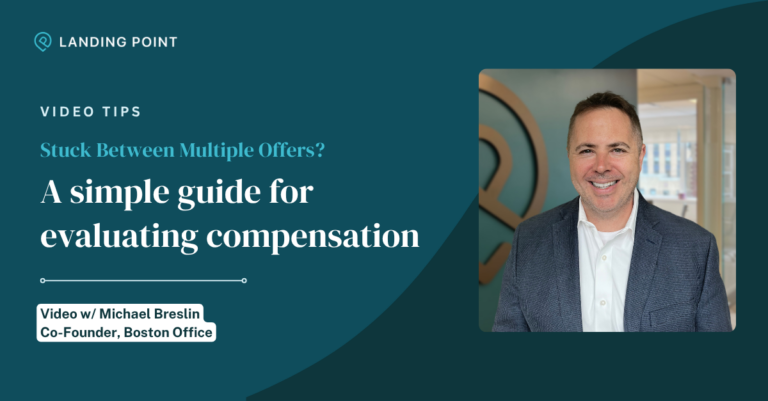
By Michael Breslin, Co-Founder
Receiving multiple job offers is an exciting position to be in, but it also comes with a unique challenge: how do you decide which opportunity is truly the best for you?
While compensation is often a major factor in that decision, focusing only on base salary can lead to an incomplete picture. Today, more companies are structuring compensation packages with long-term incentives, deferred compensation, and performance-based bonuses that significantly impact total earnings.
Evaluating offers is not just about what you will earn next year. It is about understanding the full value of each opportunity over time. Candidates who take a more strategic, long-term view of compensation are better positioned to make decisions that align with their career and financial goals.
In this video, Michael Breslin, Co-Founder and head of Landing Point’s Boston office, shares a practical framework for evaluating multiple offers and making more informed compensation decisions.
[Michael Breslin, Co-Founder at Landing Point, explains how candidates should evaluate compensation across multiple job offers using a long-term perspective.]
How to Evaluate Multiple Offers
When evaluating multiple offers, it is natural to compare base salaries first. However, that approach can overlook some of the most meaningful components of compensation. Many organizations are shifting toward long-term incentive structures, which can significantly increase total earnings over time.
Deferred compensation, profit sharing, and equity-based incentives are becoming more common, particularly in competitive industries. While these elements may not provide immediate financial impact, they can create substantial long-term value that may outweigh a higher base salary elsewhere.
That is why it is important to step back and look at the bigger picture. Projecting your total compensation over a five-to-ten-year period can provide a clearer understanding of which opportunity offers the greatest financial upside. Even though bonuses and incentives are not always guaranteed, most companies provide target ranges that can help guide these projections.
Beyond compensation, benefits and perks also play a role. Retirement contributions, healthcare coverage, and additional perks such as wellness programs or flexible work arrangements can all contribute to the overall value of an offer.
At the same time, compensation should not be the only deciding factor. If one role clearly aligns better with your long-term career goals or offers stronger growth potential, that should carry significant weight in your decision.
Ultimately, the best choice is one that balances both immediate and long-term value, financially and professionally. Taking a structured and thoughtful approach to evaluating offers helps ensure you are making a decision that supports your future, not just your next paycheck.
Looking Ahead
If you’re assessing offers and want guidance evaluating compensation, Landing Point can help. Our team works closely with candidates to break down offer structures, provide market insight, and ensure you’re making a fully informed decision.
Connect with us to gain clarity and confidence in your next career move.
Transcript
Michael Breslin:
If you’re a candidate in the job market right now and you have multiple offers, first, congratulations.
There’s a great exercise to do as you’re determining which is the right move for you. If you prefer a specific job or feel it’s the right career path, that’s typically the offer to go with.
If you’re more torn and using compensation as the deciding factor, think about how much total compensation you’ll earn over the next five, or even ten years.
More companies are putting value into long-term incentives like profit sharing or deferred compensation. So even if the base salary isn’t as high, you could earn significantly more over time.
Bonuses aren’t always guaranteed, but most companies provide a target percentage you can use as a benchmark.
You should also consider benefits, 401(k) plans, and perks like gym access or meals. But most importantly, make sure you’re evaluating compensation over a longer time horizon—not just the next year or two.
About Michael Breslin
Michael J. Breslin is a Co-Founder of Landing Point and leads the firm’s Boston office. With more than two decades of experience in executive search and finance leadership recruiting, he specializes in connecting accounting and finance professionals with opportunities in asset management, private equity, hedge funds, and software companies.
Michael’s work spans CFO, controller, and finance operations roles for mid-market and institutional investment firms throughout the Boston and Tri-State areas. Notable searches include the Global Controller for a multi-strategy investment platform and the Controller of a Boston-based global SaaS company.
Before founding Landing Point, Michael spent over a decade recruiting and three years with KPMG—an experience that provides the technical grounding and advisor credibility that clients trust. He holds a BA in Accounting from Fordham University, where he competed on the Division I swimming team. A Boston-based golfer, drummer, and youth soccer coach, Michael brings team focus and precision to every engagement.