
By Carlo Coumoutsos, Managing Partner
Why First-Round Interviews Matter More Than You Think
Many candidates approach first-round interviews with the mindset that they’re simply an introductory conversation, a stepping stone before the interviews with team members begin. In reality, first-round interviews often determine whether you’ll continue the hiring process at all. Making a strong first impression starts with understanding that not every first-round interview is the same, and your preparation should reflect that.
Whether you’re meeting with an HR professional, an internal recruiter, or the hiring manager, each interviewer is evaluating you through a different lens. Knowing who you will be meeting with and what they’re looking for allows you to tailor your responses, demonstrate genuine interest, and stand out from other candidates.
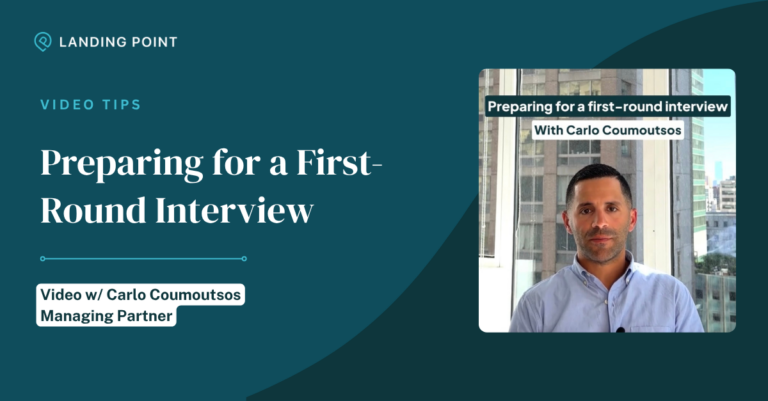
In this video, Carlo Coumoutsos, Managing Partner at Landing Point, shares why preparing for the specific conversation is one of the biggest advantages candidates can have.
Carlo Coumoutsos, Managing Partner at Landing Point, explains how candidates can prepare for a first-round interview by understanding their interviewer, researching the role, and working with their recruiter.
Key Takeaways
A successful first-round interview starts well before you log into the meeting or walk through the office doors. Taking time to research the company is important, but equally important is understanding who you’ll be speaking with. An HR representative may focus on your communication style, cultural fit, and overall career motivations, while a hiring manager will likely spend more time evaluating your technical abilities, relevant experience, and how you would solve the team’s immediate challenges.
Candidates should also spend time thinking beyond the job description. Ask yourself why the position exists:
- Is the company experiencing growth?
- Is someone leaving?
- What problems are they hoping this hire will solve?
When you can connect your experience directly to those needs, your answers become significantly more compelling.
If you’re working with an external recruiter, make the most of that relationship. Recruiters often have insights you simply can’t find online, including the interviewer’s communication style, the types of questions they tend to ask, and what qualities the team values most in this next hire. A short preparation call with your recruiter can provide context that helps you walk into the interview with greater confidence.
Finally, every candidate should be prepared to answer one simple question: Why this job?
Hiring managers want to know that you’re interested in their opportunity—not just any opportunity. Candidates who can clearly articulate why they’re excited about the role, the company, and the impact they hope to make show they’ve taken the time to put real effort into the process. Preparation isn’t about memorizing responses. It’s about demonstrating genuine interest and showing you’ve invested time in understanding the opportunity.
Looking Ahead
At Landing Point, our recruiters work closely with candidates throughout the interview process, providing insights and preparation that help them put their best foot forward. If you’re exploring your next opportunity, connect with our team to learn how we can help you navigate every stage of the hiring process.
Transcript
Carlo Coumoutsos
First impressions matter, especially during interviews. A lot of candidates treat first-round interviews like they’re all the same, but they’re not—and the way you prepare for them shouldn’t be either.
Start with who you’re meeting with. Is it an internal recruiter, an HR professional, or a hiring manager? An HR professional may be evaluating your communication skills and cultural fit, while a hiring manager is more likely to focus on your technical skills and your ability to perform the job.
Next, think about the role itself and why it’s open. What problem is the team trying to solve by making this hire, and how can you make an immediate impact?
If you’re working with an external recruiter, use them as a resource. They often have valuable insight into the interviewer’s style, the tone of the conversation, and the types of questions you can expect—information you won’t find in the job description or online.
Finally, know why you’re there. What is it about this opportunity that interests you? The interviewer should leave the conversation thinking, “This candidate doesn’t just want a job—they want this job.”
The best candidates don’t just show up prepared—they show up prepared for that specific conversation.
About Carlo Coumoutsos
Carlo Coumoutsos is the Managing Partner at Landing Point, where he oversees the firm’s Accounting & Finance, Capital Formation & Investment Support, and Tax & Family Office practices. He partners with clients across the Tri-State area and beyond on executive search and finance leadership hiring for asset management, private equity, and family office platforms.
With a background as a CPA and former PwC auditor, Carlo brings precision, credibility, and deep financial acumen to every search. Notable searches include CFOs and financial leadership roles across diverse investment entities and multi-family offices.
A hands-on mentor and integral part of Landing Point’s growth, Carlo leads the firm’s training programs, continuing education, and partnerships with academic and community organizations that support career readiness. He is known for a balanced approach that combines technical expertise with relationship depth and long-term client partnership.
Carlo holds both a BS and MS in Accounting from Fordham University and lives in New York with his wife and four sons.