
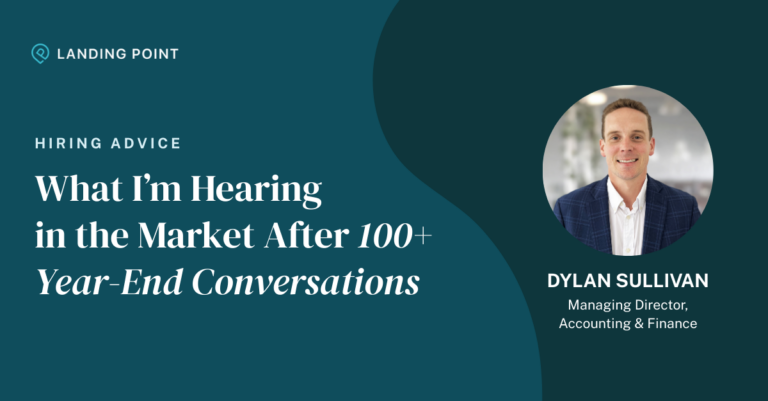
By Dylan Sullivan, Managing Director, Accounting & Finance
As we wrapped up 2025, I made it a point to do what I try to do every November and December: reconnect with my network. Over the last few months, I’ve had roughly 100 casual, off-the-record catch-ups with everyone from staff and senior accountants to finance leaders. No formal agenda. No pitch. Just conversations.
One thing that came up consistently wasn’t panic or pessimism, it was questions. People are thinking carefully about their next move, whether that’s hiring or making one themselves. I heard many versions of:
“How should I be thinking about the market right now?”
“Is this the right time to make a change?”
“What am I missing when I evaluate candidates or opportunities?”
What I’m sharing here isn’t a list of trends or hard data. These are simply my personal observations from listening closely to people who are living this market every day. A few themes came up again and again, and I think they’re worth talking about—especially if you’re trying to hire strong accounting talent or considering your next career move.
Perspectives for Hiring Firms:
When “Perfect” Becomes the Enemy of “Good”
Hiring for potential often delivers better long-term results than hiring for perfection.
I’m hearing a lot of hiring managers describe an ideal candidate who checks every single box: industry background, system experience, team size, transaction exposure, leadership style, you name it. The challenge is that insisting on a 10-out-of-10 match often means losing very capable 8-out-of-10 candidates who have real upside.
One thing I’ll add here, based on years of doing this: many of the best candidates aren’t looking for a role that mirrors what they’re already doing. They’re looking for a step forward, with more scope, new exposure, and a chance to stretch. If your “ideal” candidate is someone who has already done every part of the job exactly as written, there’s a good chance that person isn’t actually motivated by the role. The candidates who will perform best long-term are often excited by what they haven’t done yet.
In a tighter market, flexibility matters. Many of the strongest hires I’ve seen over the years are the ones who grow into parts of the role, not the ones who walk in having already done everything before.
See more: https://landingpoint.com/blog/hiring-for-potential-vs-experience/
Long Processes Aren’t Going Away, but Speed & Transparency Matter
Many firms are still committed to four- or five-round interview processes with extensive vetting. I don’t necessarily think moving away from that is realistic for everyone. What does make a difference is transparency, though I’d add an important caveat.
Even with great communication, longer processes dramatically increase the odds that you’ll lose strong candidates. I’ve seen this happen repeatedly: a company is clear, thoughtful, and prepared to make a very competitive offer, but while they’re moving through their process, a competitor moves faster. The candidate feels momentum, urgency, and excitement, and ultimately accepts the quicker offer—even when the slower-moving firm would’ve ultimately had a better offer.
You should never underestimate the impact of making a candidate feel genuinely wanted. Speed sends a signal. So does decisiveness. Transparency helps, but it doesn’t fully offset a drawn-out timeline.
That said, candidates are far more likely to stay engaged when they clearly understand:
- What steps remain in the process
- How long each step realistically takes
- Whether they are considered a lead candidate
- How to navigate your process alongside other opportunities without burning bridges
Firms that communicate clearly tend to lose fewer candidates than firms that keep people guessing—but firms that combine clarity and momentum are the ones winning the strongest talent.
A Final Thought
The biggest takeaway from these conversations is that tension exists on both sides, and often for the same reasons. Hiring firms want certainty. Candidates want clarity. The space between those two is where offers stall and great opportunities fall apart.
My role at Landing Point is to help close that gap by listening first and advising second. These year-end catch-ups are one of the most important parts of my job, and I’m grateful to everyone who took the time to share openly.
If you’re a hiring manager or an accounting or finance professional navigating these decisions and want to talk through what you’re seeing, I’m always happy to compare notes.
And for an additional take on repeated patterns I’m seeing on the candidate side of the market, see more here: https://landingpoint.com/blog/what-im-seeing-from-candidates-right-now/.
About Dylan Sullivan
Dylan Sullivan is a Managing Director at Landing Point and a leader within the firm’s Accounting & Finance practice, where he oversees executive search and advisory work for asset management, private equity, and family office clients nationwide.
With more than a decade of experience in finance leadership recruiting, Dylan partners with CFOs and COOs to help them design and scale their teams. Notable searches include CFO and Controller placements for alternative investment and growth-stage financial services firms.
Before joining Landing Point, Dylan spent four years in Audit at Deloitte’s New York office, providing him with technical accounting expertise and insight into financial operations that inform his consultative approach today. He earned both his bachelor’s and master’s degrees in accounting from Villanova University. Dylan lives in Florida with his wife and two daughters and is a dedicated sports fan who enjoys basketball and travel.